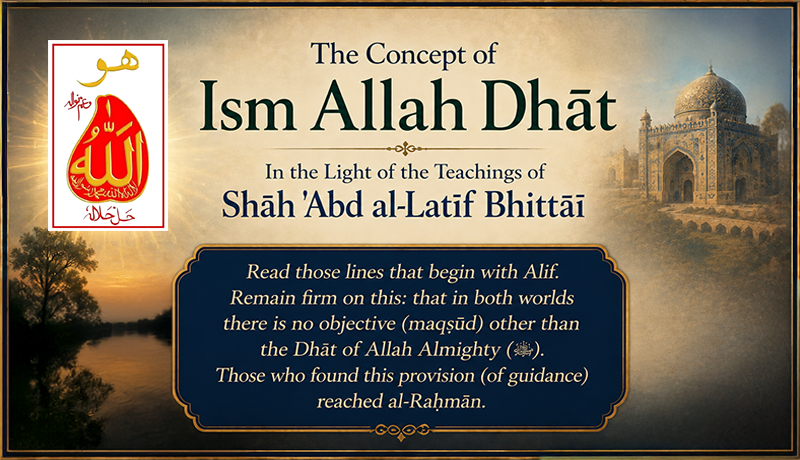
The Concept of Ism Allah Dhāt
Author: Muhammad Hanif Sumro
Teachings of Shāh 'Abd al-Latīf Bhittāī
In every age, the eminent Sufis have devoted several chapters and sections of their works to the remembrance (dhikr) and contemplation of Ism Allah Dhāt, expounding upon it through the light of the Glorious Qur'ān and Hadīth. They, through their sayings and poetry, conveyed the remembrance and contemplation of Ism Allāhu to the people at large, so that the human being might truly become the embodiment of Divine companionship and intimacy with Allah Almighty. Ism Allah Dhāt refers to Ism A'ẓam, the Glorious Name of Allah Almighty which, according to the teachings of the eminent Sufis, is inseparable from His Dhāt (Divine Essence). Its remembrance and contemplation bestow upon the dhākir (invoker of Allah's Name) the companionship of the Remembered One. In the view of Sufis, the remembrance and contemplation of Ism Allah Dhāt is a living and ever-wakeful reality through which the soul (qalb) attains contentment, the spirit (rūḥ) witnesses Divine illuminations (anwār) and spiritual-occurrences (tajalliyyāt), and the recognition (ma'rifat) of Almighty Haqq is attained.
All eminent Sufis, regardless of their language and region, shared a single mission and purpose: to guide wandering souls to their ultimate destination. In this article, the writer has endeavored to present a brief study on the concept of Ism Allah Dhāt as it appears in the teachings of Hazrat Shāh 'Abd al-Latīf Bhittāī (R.A).
The Intellectual Background of Shāh 'Abd al-Latīf Bhittāī (R.A)
Shāh 'Abd al-Latīf Bhittāī (R.A) was among the most revered Sufi poets and accomplished Ārif Billah (profound recognisers of Allah) of the Islamic world, hailing from Sindh. His intellectual and literary legacy not only occupies a milestone position within the tradition of Sufi poetry, but also stands as a luminous chapter in the spiritual and civilisational history of the Indian Subcontinent. Reference to Ism Allah Dhāt recures throughout his poetry. In his view, Ism Azam is the key that unlocks the innermost. He teaches that when any desirous of Allah Almighty becomes absorbed in the remembrance of Allah Almighty, he attains perfection in the intimacy (qurb) of Almighty Haqq. The poetry of Shāh Ṣāḥib (R.A) is, in essence, the spiritual travelogue of a sālik (wayfarer of the spiritual-path) who remains perpetually engaged in the quest for Ism Dhāt, and who keeps himself sweetened at every moment by the taste and delight of union (wisāl) with Allah Almighty.
Shāh Ṣāḥib (R.A) was born in 1689 CE in the city of Hāla, Sindh. His father, Sayyid Habīb Shāh (R.A), was a distinguished scholar and venerable elder of his time. He received his early education from Ākhund Nūr Muhammad Bhaṭṭī, while his religious and poetic formation came under the guidance of his father. In his youth, he chose solitude upon a mound of earth at some distance from his village, a place known as "Bhiṭ." It is from this association that he came to be known by the title Bhittāī. That mound subsequently became a centre of spiritualism, and a continuous stream of visitors and disciples began making their way to it. Hazrat Shāh 'Abd al-Latīf Bhittāī (R.A) died in 1752 CE at the age of sixty-three. His blessed shrine is located at the place known as Bhiṭ Shāh.
The foundation of his teachings rests upon the Glorious Qur'ān, the Prophetic traditions, and the sayings of the great masters of Sufism. His poetry collection, the Shāh Jo Risālo, is filled with the treasures of spiritual recognition ('irfān), ethics, monotheism (tawḥīd), and Divine love. What distinguishes this work is that it is arranged in the form of musical sur (melodic modes), a testament to Shāh Ṣāḥib's (R.A) profound mastery of ragas and musical compositions.
The Shāh Jo Risālo and Its Surs
The Shāh Jo Risālo is composed of approximately thirty surs. These surs not only contain the exposition of Sufi secrets and mysteries but also transform the indigenous folklores of Sindh into vessels of spiritual meaning. He has given a dimension of wisdom and recognition ('irfān) within his poetry to the stories such as Sassī Punnū, Sohni Māhīwāl, 'Umar Mārvī, and Laylā Chanesar, while the event of Karbalā has been presented as a symbol of the grandeur of sacrifice. His themes encompass the praise of Allah Almighty and the lauding of the Exalted Prophet (ﷺ), love, peace, self-discipline, spiritual-exercise (riyāḍat), and the beauty of creation.
Researchers have differed in enumerating the number of these surs. Some have given the count as twenty-seven, others as thirty, and yet others as thirty-two. The majority of researchers agree upon thirty surs, the details of which are as follows:
The Thirty Surs of Shāh Jo Risālo
| Sur Kaliāṇī | Desī | Bilāval |
| Man Kaliāṇī | Kohyārī | Dhar |
| Kambhāt | Husainī | Kāpātī |
| Sarī Rāg | Sorṭh | Ghāto |
| Sāmunḍī | Barvo Sindhi | Āsā |
| Sahaṇī | Mommal Rāṇo | Mārvī |
| Sāraṅg | Kāhorī | Dhanā Sarī |
| Kaiḍāro | Rāmkalī | Pūrab |
| SassīĀbārī | Ripal | Kāmoḍ |
| Maʿzūrī | Laylān Chanesar | Kārāyal |
Ism Allah Dhāt in the Poetry of Shāh Ṣāḥib (R.A): Selected Verses
The poetry of Hazrat Shāh 'Abd al-Latīf Bhittāī (R.A) is composed of approximately thirty surs, one of which is Sur Yaman Kaliyān. This sur has a total of eight daastaans (narrative sections). For this article, only the fifth daastaan has been selected for study. It must be noted that if the verses relating to Glorious Name (Ism A‘ḏẖam) found across the remaining twenty-nine surs (whose poetry has not been included in this article) were gathered together in one place, they would be sufficient to fill an entire substantial volume.
The Lesson of Monotheism: The Heart as the Abode of the Divine
Instructing his readers the lesson of monotheism (tawḥīd), Shāh Ṣāḥib (R.A) says:
جسي ۾ جبار جو، خفي خيمو کوڙ،
جلي تون زبان سين، چار ئي پهر چور،
فڪر سين فرقان ۾، اسم اعظم ڏور،
ٻيا در وڃي م ووڙ، اَمُل ايائين سپجي
Translation: "The heart in which the hidden tent of al-Jabbār (Allah Almighty (ﷻ)) is established, the tongue is kept pure at every hour of the day and night. Through reflection and contemplation within the Qur'ān, he discovers Glorious Name (Ism A'ḏẖam). Such a person has no need to knock at any other door because his own deeds become sufficient for him."
This verse conveys that it is necessary for the human being to keep both his outward conduct and his inward state aligned with the obedience and following of Allah Almighty. Scholars of Islamic spirituality understand the "erection of al-Jabbār's tent" to mean that Allah Almighty has created the human being for His own sake, and that the human soul (qalb) is the locus of His Divine illuminations (anwār) and spiritual-occurrences (tajalliyyāt). In the Glorious Qur'ān, Allah Almighty has declared to the human being that He is closer to him than his jugular vein (Qur'ān, 50:16):
"And We are nearer to him than his jugular vein."
The demand of monotheism (tawḥīd) is that the soul (qalb) be purified of everything besides Allah Almighty. The means to that purification is Glorious Name (Ism A'ḏẖam) which the murshid kāmil (perfect spiritual master) bestows.
Inward Reality versus Outward Appearance
Shāh Ṣāḥib (R.A) impresses upon the sālik (wayfarer of the spiritual-path) the importance of attending to inward state rather than outward appearance. Some wayfarers present an entirely different face to the world on the outside, while their souls (qulūb) are illuminated by Glorious Name (Ism A'ḏẖam) within. He says:
ظاهر ۾ زاني فڪر ۾ فنا ٿيا،
تني کي تعليم جي ڪڙه اندر ڪاني،
حرف حقّاني دور ڪيائون دل جو.
Translation: "They do not appear as ascetics outwardly; in truth, they are absorbed (fanā) in spiritual-reflection (fikr). They seek the genuine and inner teaching, and they continuously invoke within their souls (qulūb) the one Divine true letter (harf haqqānī)."
In this verse, Shāh Ṣāḥib (R.A) offers a unique insightful perspective: one must not be judged by outward appearance what lies within a person. Consider how a wasp and a honeybee both feed from the same flower, yet the bee produces honey that heals while the wasp causes harm. Both appear alike from the outside, both draw nourishment from the same source, yet their natures are entirely different. Shāh 'Abd al-Latīf Bhittāī (R.A) teaches that some sālikīn (wayfarers of the spiritual-path) will not be seen wearing the outward garb of abstinence and taqwā, yet in truth they are absorbed in spiritual-reflection (tafakkar).
In what spiritual-reflection (tafakkar) are they absorbed? They are absorbed in the contemplation of the Divine Dhāt. They are at all times in quest of Almighty Haqq. Within them is the desire of Allah Almighty, and with every breath, they continuously invoke within their souls (qulūb) the one Divine true letter, meaning Glorious Name (Ism A'ḏẖam).
The Tablet of Passionate Love: Contemplating Ism Allah Dhāt
Shāh Bhittāī (R.A) illuminates the pain of the human condition, saying that those who truly seek the purpose of their existence hold in contemplation the tablet of passionate love, that is, Ism Allah Dhāt, so that the companionship of Allah Almighty may be granted to them. He says:
جن کي دور درد جو سبق سور پڙھڻ،
فڪر فرهي هٿ ۾ ماٺ مطالع ڪن،
پنو سو پڙھن، جنھن ۾ پسن پرين کي.
Translation: "Those who are granted the round of the lesson of inner pain read and recite only that lesson. They hold the tablet of spiritual-reflection (fikr) in their hands and study in silence. They read only that page upon which the witnessing (mushāhadah) of the beauty (jamāl) of the Beloved becomes possible."
Shāh Latīf (R.A) teaches that the devoted lovers of Allah Almighty have but one occupation: they ceaselessly repeat the lesson of their passionate love ('ishq). In their hands rests the tablet of contemplation of Ism Allah Dhāt, upon which they gaze, witnessing the beauty (jamāl) of the Name of Allah Almighty. This is the lesson through whose study the lovers descend into their innermost and thereby attain the recognition (ma'rifat) and witnessing (mushāhadah) of Almighty Haqq.
The Forgotten Lesson: The True Purpose of Human Existence
Discussing the purpose of human existence, Shāh Ṣāḥib (R.A) observes that the very purpose for which the human being came into this world is the one he has forgotten today. The contemplation and remembrance of Glorious Name is precisely the fulfilment of that purpose, which the Glorious Qur'ān itself presented in the form of its very first revelation. He says in one of his verses:
وسرئوم سبق، پھرين سٽ نه سنڀران،
اڃا ھي ورق، ھي مطالع نه ٿيو.
Translation: "I forgot the lesson, and could not even hold on to the first line. Alas, even now I have not been able to study this page."
The first line of this verse contains allusions to two Qur'ānic verses. The first is the verse of the Covenant.
"And (remember) when your Lord took (the pretemporal covenant) from the Children of Adam and brought forth (all) their descendants from their loins, and made them bear witness over themselves. (He said to them:) 'Am I not your Lord?' They said: 'Yes indeed! We bear witness." (Qur'ān 7:172)
"Read in the Name of your Lord, Who created (everything)." (Qur'ān, 96:1)
Human beings today have forgotten the covenant they made before coming into this world, the covenant sealed with the words "Am I not your Rabb?" The very first lesson given at that primordial moment was the remembrance and contemplation of the Name of Allah Almighty, and the first Divine commandment was likewise to "Read with the Name of your Rabb." Yet today the human being has failed to hold even the first line of that lesson.
According to the eminent Sufis, the human being, that is, the spirit (rūḥ), existed in the world of lāhūt lāmakān before descending into this world. There, all spirits witnessed the illuminations and spiritual-occurrences (tajalliyyāt) of Allah Almighty, and that witnessing was the very sustenance of their existence. Allah Almighty asked the spirits: "Am I not your Sustainer?" All replied: "Indeed, we bear witness." In summary, the spirits were sent into this world as a trial, and within their souls (qulūb) Glorious Name (Ism A'ḏẖam) was placed, so that their love, truthfulness, and passionate love ('ishq) might be tested.
Shāh Ṣāḥib (R.A) says that today we have forgotten all of this because our spirituality is not awakened. He further says that the descent of the first revelation upon Exalted Prophet Muhammad (ﷺ) imparts to us the very lesson of reading and contemplating Glorious Name. He then expresses his lament: "Alas, the very page we were meant to study is the one we have today abandoned."
Reading with the Name of Allah: The Surs of Guidance
Enjoining the desirous of Truth upon the dhikr (remembrance) of Glorious Name (Ism A'ḏẖam) Shāh Ṣāḥib says:
سا سٽ ساريائون، الف جنهن جي اڳ ۾،
لا مقصود في الدَّارين، ان پر اتاھون،
سڳر سوٺائون، ٿيا رسيلا رحمٰن سين.
Translation: "Read those lines that begin with Alif. Remain firm on this: that in both worlds there is no objective (maqṣūd) other than the Dhāt of Allah Almighty (ﷻ). Those who found this provision (of guidance) reached al-Raḥmān."
In this verse, Shāh Ṣāḥib instructs his listeners to study carefully those sacred lines in which Glorious Name is present. He is alluding to the Qur'ānic verses:
"Allah is the Light of the heavens and the earth." (Qur'ān, 24:35)
"Allah is the Guardian of the believers." (Qur'ān, 2:257)
He teaches that the human being must study with deep attention those sacred verses in which Glorious Name resides, and that in both worlds there is no objective besides Hoo. Those who took Glorious Name their companion and guide attained access to the court of Allah Almighty.
The Reward of Union: Reaching al-Raḥmān
Shāh Ṣāḥib (R.A) then says in the next verse:
ٿيا رسيلا رحمٰن سين، سون ھين جي،
آيون تني کي، واڌايون وصال جون.
Translation: "They reached al-Raḥmān through that provision Glorious Name. Then they were granted the glad tidings and joy of the valley of union (wisāl)."
Shāh Bhittāī (R.A) teaches that Glorious Name (Ism A'ḏẖam) is the sole means through which the human being can gain access to his true Master. Those who remain absorbed in the dhikr (remembrance) and contemplation of Glorious Name attain the contentment of Haqq (jam'iyyat Haqq) and are inwardly honoured with the joy of recognition (ma'rifat) and union (wisāl). They reach that realm in which they abide in success and tranquillity, upon whom no grief or fear thereafter remains.
The Alif Lesson: No Need for Other Books
At another point, Shāh Ṣāḥib (R.A) again emphasises the contemplation and remembrance of Ism Allah Dhāt, saying:
سٽ سا ئي سار، الف جنهن جي اڳ ۾،
ناحق ڪيم نھار ،پنا ٻيا پرينء لئ.
Translation: "Read only those lines that begin with Alif. Do not needlessly search through other books."
In this verse, Shāh Ṣāḥib (R.A) declares that the indispensable lesson for the scholar is the lesson of Alif, meaning the dhikr (remembrance) of Ism Allāhu Dhāt, remaining absorbed in its contemplation, and never turning away from it. The eminent Sufis never deny the pursuit of knowledge, but they do warn that knowledge which causes distance from Allah Almighty is better avoided, while the knowledge that becomes the means of intimacy (qurb) and union (wisāl) with Allah Almighty is the most excellent and indispensable.
The Alif and the Mīm: The Reality of Prophethood
Similarly, in another verse he says:
سٽ سا ئي سار، الف جنهن جي اڳ ۾،
ميم مان معلوم ٿيو، ورق اھو ئي وار،
ناحق نھارين ،پنا ٻيا پرينء لئ.
Translation: "Read only those lines that begin with Alif. From Mīm it has become known: read only that one page. Do not needlessly search through other pages."
In this verse, Shāh 'Abd al-Latīf Bhittāī (R.A) conveys, with a slight variation, the very meaning of the preceding verse: that reading the Alif, meaning Ism Allah Dhāt, is essential. He says that by Mīm is meant the recognition (ma'rifat) of Allah Almighty and the blessed Dhāt of the Beloved Prophet (ﷺ). He instructs the sālik that once the recognition (ma'rifat) of Almighty Haqq has been granted, there is no longer any need to leaf needlessly through books.
The Reality of Prophethood (ﷺ): The Alif within the Mīm
Regarding the reality of Exalted Prophet (ﷺ) and the illuminations of Prophethood (ﷺ), he says:
ميم مان معلوم ٿيو، الف آھين تون،
تنھن لئ آيل مون، ورق سڀ ورائيا.
Translation: "From Mīm I came to know that it is none other than Alif itself. It is for the sake of this, O my dear mother, that I searched through all these pages."
Shāh Latīf (R.A) says that when recognition (ma'rifat) was granted to him, the secret manifested that within the veil of Mīm, Alif is concealed, and that hidden secret is the blessed Dhāt of the Prophet (ﷺ) himself. He says that it was precisely in order to reach this exalted point that he studied all books. The blessed Dhāt of Exalted Prophet Muhammad (ﷺ) is the very source and fountain of Divine illumination. He (ﷺ) is the very reason for the creation of the universe. From his blessed spirit (rūḥ) were all spirits created. Through the blessed Dhāt of the Prophet (ﷺ), the illuminations and spiritual-occurrences (tajalliyyāt) of Allah Almighty are manifested.
Ploughing the Field of the Heart: 'Ilm Ladunnī through Glorious Name
Regarding the ultimate purpose and objective of knowledge, which is access to the Dhāt of Allah Almighty, Shāh Ṣāḥib (R.A) says:
ھيرائج ھينئن ۾، الف سندي اوڙ،
ڪتابن جي ڪوڙ، منجهان ئي معلوم ٿئي.
Translation: "Plough the field of the heart with Alif. Then shall the meaning of millions of books become known to you from within."
Shāh Latīf (R.A) says that make the ground of your chest smooth and plough the field of your heart, meaning invoke Glorious Name and plant its seed in the soil of the heart. When that seed is nourished and watered, the innermost will be illuminated and all knowledge will be unveiled. The sincere dhākir (invoker of God's Name) will be granted inspired knowledge ('ilm ladunnī). For Allah Almighty taught Hazrat Ādam (A.S) the names of all things, and all of that knowledge lies concealed within every human being's innermost. It is unveiled through Glorious Name.
Bismillāh: The Essence of All Knowledge
In similar vein, regarding the grandeur of Bismillāh al-Sharīf and Ism A'ẓam, Shāh Ṣāḥib (R.A) says:
ڪوڙئين ڪتابن ۾ اکر مڙيو ئي ھيڪ،
جي تون نظر نيڪ، ته بسم ﷲ ئي ٿئي.
Translation: "In millions of books there is but one letter. If you have a righteous vision, then Bismillāh alone is sufficient for you."
In this verse, Shāh Latīf (R.A) declares that the essence and distillation of all knowledge and all books is a single word. If the sālik purifies not only his outward, but also his innermost, the secret of sanctified Bismillāh is granted to him. The meaning of Bismillāh is to begin every act with the sacred Name of Allah Almighty.
The Alif of the Heart: Purifying the Innermost
In yet another verse, Shāh Ṣāḥib (R.A) illuminates the importance of Ism Allah Dhāt in this manner:
اکر پڙه الف جو، ٻيا ورق سڀ وسار،
اندر تون اجار، پنا پڙهندين ڪيترا.
Translation: "Read only the one letter of Alif. Forget all other pages. Cleanse your innermost. What need have you to read anything more?"
In this verse, Shāh Ṣāḥib (R.A) expounds upon the Qur'ānic declaration (Qur'ān, 55:1-4):
"The Most-Compassionate (Lord), has taught the Qur'ān. He created the human being, (and) taught him to communicate."
He says that the human being must read the lesson of Alif Allāh and set aside all else. The second line carries two meanings: the first is a command to uproot from within oneself the nafs (base-self), Satan, and all unlawful attachment to the material world, and to create an environment within that is congenial to the spirit (rūḥ); the second meaning is that purifying the innermost is essential so that one no longer needs to read through vast numbers of books. For Allah Almighty taught Hazrat Ādam (A.S), and the spirit (rūḥ) carries that knowledge within itself.
A Supplication at the Threshold: The Practice of Dhikr
Shāh Ṣāḥib (R.A) presents his supplication before his true Master and enjoins the desirous of Allah Almighty to purify their innermost through Ism Allah Dhāt. He says in one of his verses:
پڙهڻ ته پروڙڻ، نه ته پڙهڻ آه مذاق،
سبق سپرين جي اندر ڪيئي اوطاق،
پار لنگھائين پاڪ، آئون حرف نه ڄاڻا ھيڪڙو.
Translation: "If you read, then practise it also. Otherwise reading becomes nothing but mockery. The longing of the Beloved has set up its dwelling within me. O Pure Being, take me across. I do not even know a single letter."
Shāh Ṣāḥib (R.A) advises the sālik that if he has acquired knowledge, he must act upon it, because knowledge without action is mere mockery. He then says, "read the lesson of that Being Who has made His dwelling within your heart, that is, contemplate Ism Allah Dhāt." He then implores, "O my Master, You alone take me across to that other shore, for in truth I do not know a single letter." The acquisition of knowledge, understanding, and seeking must be accompanied by the station of not-knowing (nami dānam), for apart from Divine Court, the human being knows nothing. As the expression goes: Allaho bas mā siwa Allah hawas (Allah is sufficient, and everything besides Allah is mere temptation).
The Dhikr of Glorious Name in the Late Hours of the Night
Shāh Ṣāḥib (R.A) also enjoins the dhikr (remembrance) of Glorious Name in the late hours of the night, after midnight. He says:
فاذۡکروني اذکرکم، اھو سڳو سُور،
اٿي آڌيء رات جو، تون اسم اعظم ڏُور،
اھو چرخو چور، ته پاڻ پسين پرينء کي
Translation: "Allah says, 'Remember Me, I shall remember you', turn this rope of breaths. After the middle of the night, perform the dhikr (remembrance) of Glorious Name. Set this wheel of breaths in motion so that you may witness the Beloved."
In this verse, Shāh Ṣāḥib (R.A) draws upon the Qur'ānic command, wherein Allah Almighty commands to the believing servant to engage in dhikr Allāh.
He says that the desirous must keep both his breaths, the incoming and the outgoing, absorbed in the dhikr (remembrance) of Allah Almighty, and must perform the dhikr (remembrance) and contemplation of Ism Allah Dhāt at the time of tahajjud, when the people at large are asleep and all around is stillness and darkness. Through the dhikr (remembrance) of Ism A'ẓam, the desirous attains the witnessing (mushāhadah) of the Dhāt of the Beloved Almighty Haqq.
The Dhākir of Ism Allah Dhāt: A Being of Living Worship
Describing the grandeur of the dhākir (invoker of God's Name) of Ism Allah Dhāt, Shāh 'Abd al-Latīf (R.A) says:
تن تسبيح من مڻيون، دل دنبورو جن،
تندون جي طلب جون وحدت سُر وڄن،
وحدہ لاشریک له اھو راڳ رڳن،
سي ستا مر سونھن، ننڊ عبادت جن جي
Translation: "The human body is a rosary (tasbīḥ), the inner self is its bead, and the heart is the stringed instrument (tanbūra). Set its strings in motion with the dhikr (remembrance) of Oneness. When the raga of Oneness resounds, dhikr will flow through every vein of the entire body. Even if such persons sleep, their sleep itself is worship."
In this verse, Shāh Ṣāḥib (R.A) draws a profound analogy between the human body and a musical instrument. He says that the human body is like a rosary (tasbīḥ), and the inner self (of man) is its bead. The breath that moves in and out of the heart becomes the string of the instrument (tanbūra). When the dhākir performs the dhikr (remembrance) of Ism Allah Dhāt through his very breath, dhikr (remembrance) flows through every vein and fibre of the entire body. If the dhākir is even asleep, his sleep itself is pure worship, just as Exalted Prophet (ﷺ) said, "My eyes sleep, but my heart does not fall asleep."
Conclusion
If a thorough and deeply attentive study were to be conducted on the theme of the "contemplation and remembrance of Ism Allah Dhāt" within Hazrat Shāh 'Abd al-Latīf Bhittāī's (R.A) Shāh Jo Risālo, several volumes could be produced on this subject alone. In this article, the writer has humbly presented a selection of verses before the readers so that the importance of Glorious Name (Ism A'ḏẖam) within the poetry of Shāh Ṣāḥib (R.A) may be read and understood. May Allah Almighty grant us all the Divine-ability (tawfīq) to truly understand the teachings of the eminent Sufis and to act upon them, so that we may purify our souls (qulūb) and secure our hereafter. Āmīn.
Note: This article was first published in Mirrat-ul-Arifeen International in Urdu language.
To cite the original article: Sumro, Muhammad Hanif. "Tasawwur Ism Allah Zat: Taleemat-e Shah Abdul Latif Bhittai ki Roshni Mein." Mirrat-ul-Arifeen International, March 2026. Available at https://www.mirrat.com/article/1/1740