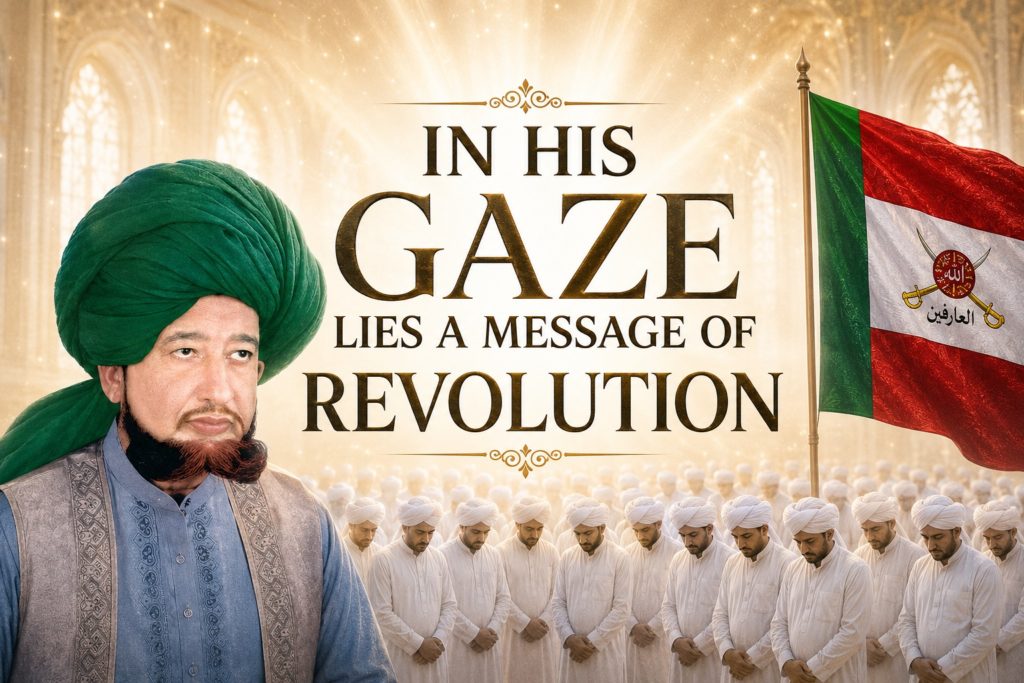
In His Gaze Lies a Message of Revolution
Written by: S. H. Qadri
“In my heart there is a constant longing that some desirous of Allah Almighty would come close to me, for what comes after is my responsibility.”
These blessed words of the founder of the Islahee Jamaat and Aalmi Tanzeem Al-Arifeen (Edifying Movement), Sultan Muhammad Asghar Ali, are the truest reflection of the Persian poetry of Sultan al-Arifeen Sultan Bahoo inscribed upon the portal of his blessed shrine:
هر کہ طالبِ حق بود من حاضرم ز ابتداء تا انتہاء یک دم برم
طالب بیا، طالب بیا، طالب بیا تا رسانم روزِ اول با خدا
“Whoever is desirous of Truth, I stand ready and present before him; from the initial stage to the final, I will take him in a single breath. Come, O desirous! Come, O desirous! Come, O desirous! That I may take you to God on the very first day.”
He who acquainted the Muslims of the present age, gathered as one community, with the profound reality of,
“The hand of Allah Almighty is upon the congregation” (Yad Allah ‘ala al-Jamā’ah); he who breathed the living, eternal spirit of Islam, born fourteen centuries ago, into the lifeless veins of the contemporary era; he who revived spirituality and, fulfilled “Come out of the monastery and play the role of Shabbir (Imam Hussain)”, the sacred tradition of selfless struggle in a new form tailored to modern requirements; he who extracted the subtle nuances of Sufism from the Glorious Qur’an, the Hadith, and scholarly treatises, weaving them into the fabric of human character, the spiritual heir of Sultan Bahoo, dispenser of his treasury of Divine knowledge and Gnosis (ma’rifat), and living exemplar of heart-conquering love: is Sultan Muhammad Asghar Ali. Whoever accessed his blessed presence, whether a disciple or an ordinary visitor, received but a single heartfelt prayer from his blessed lips, “May Allah Almighty be pleased with you.”
It was precisely this warm, loving demeanour, a heart and gaze overflowing with tenderness, that healed broken hearts, reawakened minds and souls trapped in despair, and guided a restless world searching for inner contentment onto the sacred path of Divine remembrance,
“Indeed, it is by Allah’s remembrance that hearts find peace.” (Qur’an, 13:28)
When we examine the various dimensions of his life, we discover that in early childhood he endured the deep grief of losing his respected mother. Yet, he never forgot the love she bestowed upon him, making it his lifelong practice until his final years to regularly visit her resting place. Sultan Ahmed Ali stated that it was the blessed practice of Sultan Muhammad Asghar Ali that whenever he undertook a journey by means of hunting, as an accessible means to comfort desirous and serve humanity, he could not turn back midway before reaching his intended destination. Highlighting this unwavering commitment, Haji Muhammad Nawaz Qadri, Chief Administrator of Edifying Movement, recalled his sacred statement,
“Sultan Muhammad Asghar Ali stated,
‘My blessed spiritual master has assigned me this explicit duty: to travel far and wide and bestow the knowledge of Divine recognition (ma’rifat) upon the creation. I am commanded to invite humanity toward the eternal treasure of Divine lights, while people continuously ask me for the fleeting material possessions of this world’.”
However, on one occasion during a journey, his respected mother’s death anniversary fell while he was travelling. He immediately departed for the shrine before completing the planned journey so that the prayer of spiritual rewards for his pious mother could be observed. Sultan Ahmed Ali expressed this deep family love and devotion in these words,
“Sultan Muhammad Asghar Ali was still young when the passing of his respected mother happened on the 23rd of Ramadan. He would arrange her memorial prayers with utmost care, making every effort to be present at the noble shrine on the 23rd of Ramadan. A year or two before his passing, when the 23rd of Ramadan coincided with a hunting tour, he stated,
‘It is the memorial ceremony of my blessed mother. I shall leave the hunt and go there for the ceremony.’
Even though he never cut short a hunting trip for anything else. He returned to the shrine on that very day. He would frequently highlight three noble distinctions of his mother: first, she had the honour of being married to a spiritual master; second, none of her children abandoned the Islamic Divine Law; and third, none of her children ever had any doubt cast upon their moral character.”
While a mother’s loving upbringing plays a vital role in human development, in the life of Sultan Muhammad Asghar Ali, the absence of maternal affection was fulfilled extraordinarily by his spiritual master, mentor, and respected father, Sultan Muhammad Abdul Aziz. Their bond transcended the conventional father-son relationship, manifesting as a deep spiritual unity between lover and beloved. From accounts of the spiritual intimacy between Sultan Muhammad Asghar Ali and his spiritual master, it is impossible to discern who was the lover and who the beloved. It perfectly embodies the profound insight of Sultan Bahoo, where passionate-love, passionate-lover, and passionately-beloved merge into a single reality. On one hand, his father and spiritual guide cherished him so deeply that everyone witnessed his profound affection, calling him ‘Moon’. Anyone who looked upon his radiant face would spontaneously exclaim,
“A vessel filled with Divine illumination has arrived!”
On the other hand, he dedicated himself to twelve continuous years of night vigilance in the immediate service of his spiritual master. By awakening the whole night, he used to perform spiritual exercises, as Sultan Ahmed Ali describes the details of this nocturnal service,
“Whenever Sultan Muhammad Abdul Aziz rose for late-night vigil prayers (pre-dawn prayer) and came out, tea was served immediately; if there was any delay, he would decline to take it. A spiritual seeker had been assigned on this duty; I might not be able to describe it explicitly, but after he delayed on a couple of occasions and the master refrained from taking tea, Sultan Muhammad Asghar Ali humbly requested,
‘My master, if you would be so gracious, assign this duty to me.’
For twelve consecutive years, he remained awake throughout the night. The moment Sultan Muhammad Abdul Aziz departed to offer his late-night prayers, Sultan Muhammad Asghar Ali would place the tea on the stove, and as soon as his master returned and sat upon his blessed bed, he placed the fresh tea right beside him. This account was confirmed by Mian Muhammad Ali from Jhang district, a senior disciple who served Sultan Muhammad Abdul Aziz from his youth that when Sultan Muhammad Abdul Aziz went to rest, a small oil lamp remained lit in the room and Sultan Muhammad Asghar Ali did not sleep; instead, standing respectfully at the foot-side of the bed in a posture of standing, he spent entire nights gazing upon the blessed face of his spiritual master.”
Elucidating this elevated station of annihilation in the master (fanā fi shaykh), Sultan Ahmed Ali explains,
“The face of a perfect spiritual master is not like an ordinary human face. Just as common paper produced in a factory is made from ordinary materials, yet when the Glorious Qur’an is written upon it, it is no longer thrown aside but kissed and held in high esteem, because when the Word of Allah is written upon the pages, their status ceases to be ordinary. In the same way, when Divine mercy descends upon a human face, and the Name of Allah (Ism Allah Dhāt) is inscribed upon it, that face does not remain ordinary, and it acquires the sanctity like that of a Qur’anic page. Looking at a page of the Glorious Qur’an is an act of worship, and contemplating it is an act of worship; similarly, gazing upon the face of a perfect spiritual master, upon whose countenance the Name of Allah is written and upon whom Divine mercy rests, is itself an act of devotion, contemplating such face is act of worship and he did such devotion.”
After explanation of the station of annihilation in the spiritual master, there is no need for further explanation. Attaining such status of annihilation is not a mere theoretical concept, but a living reality practically demonstrated in the blessed life of the Sultan Muhammad Asghar Ali. My late teacher Said Amir Khan Niazi shared his personal experiences,
“Person of spiritual excellence (faqīr) is like a fruit-bearing tree; people hurl stones at it, yet it responds by bestowing fruit. The true sign of an authentic desirous of God who receives the special grace of his spiritual master is that his every state becomes completely aligned with the state of his master, and such desirous is annihilated in master. At twenty-four years of age, every single act of Sultan Muhammad Asghar Ali matched that of his spiritual master, exactly and completely. Even after his master’s physical passing, the vocal tone and cadence of Sultan Muhammad Asghar Ali were identical to those of Sultan Muhammad Abdul Aziz. If someone listened from behind a wall, it felt as if Sultan Muhammad Abdul Aziz himself was speaking. It is worth noting that when a desirous attains annihilation in the master, he becomes his reflection in every way, both outwardly and inwardly. Whatever deeds the spiritual master performed, he performs them outwardly in exactly the same manner.
While staying at the residence of the late Fazal Karim Khan Kundi in Dera Ismail Khan, Sultan Muhammad Asghar Ali looked closely at my face and said,
‘Niazi Sahib, trim my nails.’
I asked,
‘Shall I trim your nails?’
He replied,
‘Yes, Niazi Sahib, who else will trim them?’
The way he said it instantly brought back the memory of when I had trimmed the nails of Sultan Muhammad Abdul Aziz at the doorway of Sayyad Sultan Bahadur Ali Shah, i.e., as the master stood before the mirror preparing to enter the main hall, he asked,
‘Khan Sahib! Call a barber to trim the nails.’
I submitted,
‘Please, I will trim your nails.’
He said,
‘How will you trim?’
At that era, nail clippers were new in the market, and I had one in my pocket. I requested,
‘Honourable, please, I may trim your nails.’
I trimmed his nails on the spot, bringing immense joy to the master, and he said,
‘What a pleasure it is.’
Although Sultan Muhammad Asghar Ali was not present on that earlier occasion, he had not seen me trimming the nails (of Sultan Muhammad Abdul Aziz). When I trimmed his nails with the nail clipper, he asked,
‘Niazi Sahib, is it all right now?’
I affirmed, ‘It is perfectly all right.’
Thus, there was not a single practice of his spiritual master that he had not fully adopted as his own.”
The profound spiritual attachment between father and son was not hidden from people aware of secrets. Annihilation in the love of such a master is not useless worship if one can find such a perfect spiritual master because he follows the footsteps of the Exalted Prophet (ﷺ). The greatest distinguishing mark of complete spiritual succession is an unbounded love for the Glorious Qur’an and its Exalted Conveyor (ﷺ). Sultan Muhammad Asghar Ali maintained a deep, lifelong bond with the Glorious Qur’an, obvious to everyone, regularly conducting Qur’anic lessons with translation and exegesis for his family, disciples, and attendants. Sultan Ahmed Ali described these gatherings,
“He would most frequently teach the commentary Nūr-ul-‘Irfān both at home and to disciples. He also maintained the blessed custom of listening to the recitation of the Glorious Qur’an recorded by Qari Ghulam Rasul, accompanied by the translation of Wajih-ul-Seema Irfani. Eminent scholars, including Sultan Muhammad Muazzam Ali, Haji Muhammad Nawaz Qadri, Mufti Salih Muhammad, and Mufti Ashfaq Ahmad, would join the assembly. As verses were translated, recitation was paused while scholars offered commentary, and gatherings often continued through the night in deep deliberation over the Glorious Qur’an. Disciples listened attentively and asked questions while he explained the esoteric secrets and spiritual realities of the Glorious Qur’an.
While explaining the contemplation of the Supreme and Glorious Name of Allah (Ism A’ẓam) and the teachings of Sultan Bahoo, his facial expressions, body language, and entire posture underwent a sublime transformation, his radiant countenance glowing so brilliantly that it shone even in darkness.”
From among the people involved in organizing gatherings of the Edifying Movement from its earliest days, some have told me that special care was taken to avoid professional reciters who performed for financial gain or applause. Preference was given to non-professional reciters having sincere voices. Similarly, preference was given to authentic scholars who taught true religion to people. Instead of professional reciters, well-known Qur’anic reciters were prioritized because the recitation of the Glorious Qur’an illuminates human hearts. This was the condition of his love for the Glorious Qur’an. Now listen to Haji Muhammad Nawaz Qadri about love and respect for the Glorious Qur’an. He relates two unforgettable accounts demonstrating his deep reverence for the Exalted Prophet (ﷺ) during visits to Mecca and Madinah,
“On one occasion during Eid at the Prophet’s Mosque (masjid an-nabawī), there was an immense crowd and no space was available to lay the prayer mat for our master. Disciples suggested going to the upper floor, but he forbade it, stating,
‘This is contrary to proper respect (adab), and there is no benefit in offering Eid prayer in this manner.’
At that very moment, a space for two persons miraculously opened up near the blessed sanctuary, which was astonishing for us, allowing him to offer Eid prayer there.”
While going to the upper floor is not impermissible, his profound love demanded that he remain close to the Sacred Enclosure in direct face-to-face presence. Haji Muhammad Nawaz Qadri further narrates,
“On the side near the sacred shrine adjacent to the platform of the Companions of the Bench (aṣḥāb al-ṣuffah), he would sit reciting the Glorious Qur’an. While reciting, he would gently embrace and kiss the walls of the Sacred Shrine. Interesting was the fact that whenever someone from officials had a look, he perceived it as only recitation of the Glorious Qur’an. He kept on kissing the Sacred Shrine and would tell us,
‘The most refined way to express love and kiss the sacred sanctuary of the Exalted Prophet (ﷺ) is precisely this’.”
Despite possessing vast ocean-like spiritual excellence, at major public gatherings of Mawlid (Milād-un-Nabī) or spiritual commemorations for Shaykh Abdul Qadir Jillani held by Edifying Movement, he engaged scholars to speak rather than delivering public addresses himself. Haji Muhammad Nawaz Qadri recalled a revealing conversation regarding his master not delivering public addresses,
“Once coming back from Uchali to the shrine, there came Khaliqabad during the journey; he rested there for some time. There were some disciples, and one disciple respectfully inquired,
‘My master, you do not deliver public speeches like your esteemed brothers Sultan Muhammad Farooq and Sultan Muhammad Muazzam Ali. Why do you not deliver addresses?’
He replied,
‘There is no command for us to do so.’
He then added the Punjabi proverb,
ہوویں سونا تے سڈاویں سِکہ
[who are like pure gold but show as lead (out of humility)]
‘Let the gold be pure, and it will speak for itself.’
He declared, ‘Our duty is to make others capable of speaking’.”
Sultan Ahmed Ali shared a personal experience illustrating this unique method,
“Once I had a meeting with a senior political leader of Pakistan, I introduced him to the Edifying Movement, its founder, and the ideology of the organization. The truth and sincerity behind the Edifying Movement’s ideology possess a power and force that speaks for itself—which in journalistic terms is described as ‘working like magic.’ This ideology is completely pure, free from all kinds of typical political drama, and devoid of sectarian conflicts. I introduced him to the workers of Edifying Movement through this reference, highlighting that Pakistan has such dedicated workers. He himself came to attend one of our programs. When he observed the discipline of the workers there, listened to the discussions taking place, and saw the contentment, satisfaction, peace, and smiles on the faces of those who asked questions, as well as their commitment and ideological clarity, he was deeply impressed. After returning from the program, when he met me again to express his gratitude, he asked,
‘O Sahibzada! Can I get any written work of the founder of the Edifying Movement to read?’
I replied,
‘He did not write any text.’
Then he asked,
‘Can I get any speech of him that I could watch or listen to in audio?’
I replied,
‘He never delivered a speech.’
He was completely astounded and asked me in great amazement,
‘Then how is there so much commitment among the workers? Leaders inspire people through captivating speeches, cultivate their thought, or write texts, or often do both—so how is he a leader, how is he a founder, how was he a caller to the faith who neither wrote nor delivered a speech, yet I am astonished at how he produced such high commitment among the people?'”
Behind this apparent silence lay the profound prophetic wisdom described by Allama Iqbal in Pas Chih Bāyadh Kard ‘Ay Aqwām-e-Sharq:
پختہ سازد صحبتش ہر خام را
تازہ غوغائی دہد ایام را
درسِ اُو اللہ بس باقی ہوس
تا نیفتد مردِ حق در بندِ کس
بحر و بر از زورِ طوفانش خراب
در نگاہِ اُو پیامِ انقلاب
“His companionship ripens every unrefined soul, bringing fresh vitality to the passage of time. His lesson is ‘Allah suffices, all else is mere desire,’ so that the man of truth falls captive to no mortal, arrogance or deception. Sea and land lie overwhelmed by the power of his spiritual storm; in his gaze lies a message of revolution.”
In fact, from the person possessing true spiritual insight, reflecting the sacred Hadith,
“beware the spiritual insight of the believer, for he sees with the light of Allah Almighty,”
the condition of their disciples and people close to them is not concealed. As Said Amir Khan Niazi related a personal incident demonstrating the spiritual insight and inspired knowledge of Sultan Muhammad Asghar Ali. He states an incident experienced by himself,
“The blessed spiritual master (Sultan Muhammad Asghar Ali ) commanded me,
‘O Niazi, reach Jhang urgently.’
I left Kamaliya immediately and arrived. He said,
‘O Khan, I have called you because I wish to spend nine nights at the shrine of Sayyad Bahadur Ali Shah, and I thought I should have some companion with whom the heart remains happy. My gaze of choice fell upon you, and that is why I have called you.’
I saidm ‘Sir, I am present.’
At that time, there was an urgent need for two thousand rupees in my home, and I was thinking: from where will I get these two thousand rupees? There is no means; who knows when the money will come? Anyway, I came here. From here we went to the shrine. I wish to spend nine nights at the shrine of Sayyad Bahadur Ali Shah. The blessed spiritual master arrived and went into the room to change his clothes.
Whenever he went to the blessed shrine, he would put on completely fresh clothes, then perform ablution, then present himself at the blessed shrine. I thought I would quickly go and offer my greetings at the blessed shrine because afterwards he would sit for a long time at the blessed shrine and I should offer my greetings first. I was offering my greetings at the blessed shrine when the thought of the two thousand rupees came into my heart again,
‘Friend, what will happen with the household? There was a need for two thousand rupees. Anyway, now that I have come here and have to spend nine nights here, when we go back we will find some solution for it.’
We spent nine nights there. When we had completed the nine nights and were about to leave, I walked out and came to the road. At the Adda Qasimabad stop, he said,
‘O Khan, now what do you think? What is the plan?’
I said, ‘My master, what is your plan?’
He said, ‘We are going home to Darbar Haq Bahoo.’
I said, ‘My master, I will come with you as far as Malhu Mor, then I will go to Jhang.’
He said, ‘Very well then, Masha Allah.’
The moment I stepped out at Malhu Mor and kissed his hand, he turned back and looked at Latif Khan, who was his caliph, and said,
‘Latif Khan! Those two thousand rupees I gave you to keep separately in your pocket, are they there?’
He said, ‘Yes, sir.’
He said, ‘Give them to Said Amir Khan.’
He placed them in my hand. They were perhaps five-hundred-rupee notes. I was just about to ask what I should do with these when the car started and he said,
‘Niazi Sahib, these are your own. Spend them on household expenses’.”
Whoever had the opportunity to remain in his service knew that in his presence one generally did not need to express something in words verbally. He would resolve or declare the matter himself in accordance with the intention and the thought formed in the heart. These special kindnesses and favours were not reserved for disciples alone. Whoever came to his presence, he would console and encourage. Whether those who came to meet him had a spiritual connection with him or no connection at all, he would treat all with equal generosity. Indeed, the more broken-hearted a person was, the more encouragement he would receive from him.
In the summers, he would travel to Uchhali Sharif Bangla Haq Bahoo in Khushab District. The moment news of his arrival reached the people of the surrounding areas, a steady stream of meetings and visits would begin. On one occasion at the old Bangla Haq Bahoo, there was a large crowd of visitors, and people were being blessed with his company and visitation. Among them, an elderly man also came to meet Sultan Muhammad Asghar Ali and joined the line. Someone expressed contempt and pushed him. The way of meeting was that each person would kiss his hand, place it upon their eyes, and step back. When that elderly man, who had been pushed aside, came forward to meet Sultan Muhammad Asghar Ali, his frailty and advanced age certainly weighed heavily upon him, leaving his heart deeply mourned; yet, the longing to kiss the hand of Sultan Muhammad Asghar Ali gave him the courage to rise once more and stand in line. As the elderly man finally drew near, the master opened both arms, embraced him warmly to his chest, and spent a long time inquiring after his well-being. Seeing this, the person who had pushed him looked on, filled with profound shame and wringing his hands in regret.
It was this deep spiritual care and affection that transformed thousands of lives, drawing souls toward Divine love. A whole world sacrificed the vibrant red richness of their hearts at the dust of his humble steps. Allama Iqbal unveils the secret of love in Armaghān-e-Ḥijāz:
محبت چیست؟ تاثیرِ نگاہی است
چہ شیریں زخمی از تیرِ نگاہی است
“What is love? It is the lasting effect of a single glance. How sweet is the wound left by the arrow of that glance!”
A single glance of his profound love brought a revolutionary transformation to the lives of thousands of souls. Some devoted themselves entirely to his noble community, stepping forward as fellow travellers in this practical striving for the elevation of the faith, while others stood steadfastly behind the scenes to support the mission of Sultan Muhammad Asghar Ali. Today, this sacred legacy and spiritual chain continue to flourish seamlessly under the leadership of the Spiritual Successor of Sultan Muhammad Asghar Ali, Sahibzada Sultan Muhammad Ali.
مردِ خدا کا عمل، عشق سے صاحبِ فروغ
عشق ہے اصلِ حیات، موت ہے اس پر حرام
“The deeds of the godly radiate with Divine love; love is the essence of true life, upon which death is forbidden.“
This article was originally published in Urdu in the Monthly Mirrat ul Arifeen International Magazine, October 2015 issue.
To cite the original publication:
- H. Qadri. “Dar Nigahe Ou Payam-e-Inqilab.” Monthly Mirrat ul Arifeen International, October 2015. https://www.mirrat.com/article/114/1695