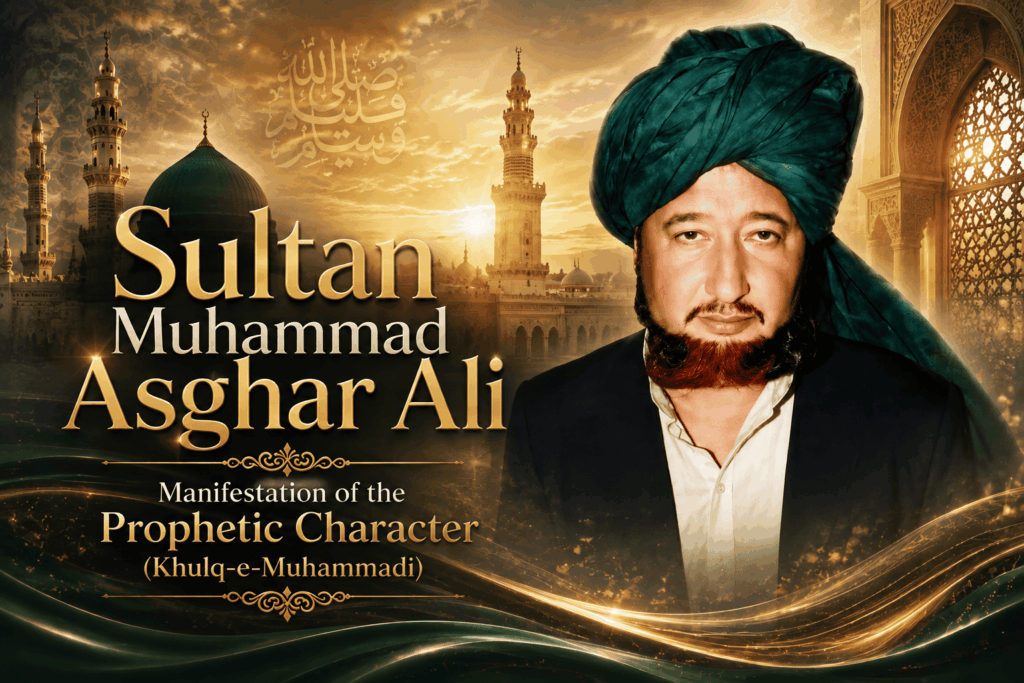
Sultan Muhammad Asghar Ali Manifestation of the Prophetic Character (Khulq-e-Muhammadi)
Written by: Allama Inayatullah Qadri
Births and Ancestors
Sultan Muhammad Asghar Ali traces his lineage back to Honourable Ali ibn abi Talib (R.A). Moving forward through Imam Muhammad Baqir, Imam Jafar Sadiq, Imam Musa Kazim, Imam Ali Reza, Imam Muhammad Taqi, Imam Ali Naqi, Imam Hasan Askari, it reaches Qutb Shah. It ultimately connects to Sultan al-Arifeen Sultan Bahoo. Sultan Bahoo was born in 1231 AH in the fort of Shorkot, to Hafiz Bazaid Muhammad, a righteous, pious, and a personality among the chosen servants of Allah.
The mother of Sultan Bahoo was Bibi Rasti, an extremely pure and saintly personality. Sultan Bahoo is ‘A Sufi by Birth’ and regarded as Master of spiritual excellence (sultan-ul-faqar). Sultan Muhammad Asghar Ali was born in the 9th blessed generation of Sultan Bahoo on August 14, 1947 AD, corresponding to 27 Ramadan (Shab Al-Qadr: A blessed night in the holy month of Ramadan). His esteemed father and spiritual guide is Sultan Muhammad Abdul Aziz, belonging to the 8th generation among descendants of Sultan Bahoo.
The birth of Sultan Muhammad Asghar Ali, on the 27th night of Ramadan, was not a mere coincidence, but rather a profound wisdom of Divine power. The world knows that this is the very day when the Muslims of Indo-Pak Subcontinent were blessed with an Islamic country (the Islamic Republic of Pakistan) under the leadership of Quaid-e-Azam Muhammad Ali Jinnah.
Undoubtedly, both of these events were not accidental; rather, they are the fountainhead of Divine confirmation. History bears witness that the birth of Sultan Muhammad Asghar Ali served as the underlying cause for the formation of the Islamic Republic. The birth of Sultan Muhammad Asghar Ali is a gift to the country of ‘Pakistan,’ whose circumstances, historical events, and sacrifices closely resemble those of the State of Medina (Riyasat-e-Madina)—a resemblance that is evident to all.
Early Education
Sultan Muhammad Asghar Ali began his education in his native district of Jhang and passed his matriculation examination from Nowshera, a renowned town in the Soon Valley, District Khushab. From the very beginning, his primary interest lay in religious studies and the path of Sufism and spiritual excellence. Afterwards, he received all his exoteric and esoteric training from his esteemed father and spiritual master, Sultan Muhammad Abdul Aziz. From the very beginning, through his insightful vision of spiritual excellence, he realised that his education and training were destined by his spiritual master. Therefore, he was not only deeply attached to Sultan Muhammad Abdul Aziz, but loved him to the extent of true devotion. In the training of Sultan Muhammad Asghar Ali, the service, obedience, love, devotion and passion remained his guiding light. This made him an exceptional leader, a great guide, and a perfect spiritual mentor. He received boundless kindness and affection from his spiritual master, leaving no deficiency whatsoever in his exoteric and esoteric training. He served Sultan Muhammad Abdul Aziz with such absolute devotion that for a complete twelve (12) years, he personally prepared and served the morning tea precisely at four 4 o’clock every morning to his spiritual master according to his daily routine. He took over this punctuality-demanding duty when the previous caliph in charge often failed to deliver tea on time. Sultan Muhammad Abdul Aziz maintained a strict daily schedule including fixed times for meals. If his meal was delayed by even a single minute, he would not consume it and would spend the entire day fasting. This is why Sultan Muhammad Asghar Ali took over this responsibility and fulfilled it immaculately for twelve (12) consecutive years.
Sultan Muhammad Abdul Aziz, who was the esteemed father and perfect spiritual master of Sultan Muhammad Asghar Ali, administered his spiritual oath into the Sarwari Qadiri spiritual order by placing his hand upon the shrine of his own spiritual master, Sultan Sayyad Muhammad Bahadur Ali Shah. It is worth noting that Sultan Muhammad Bahadur Ali Shah, a direct descendant of renowned Sufi Shah Abdul Latif, popularly known as Imam Bari Sarkar, holds the exalted and unique status among the most beloved spiritual-caliphs of Sultan Bahoo.
Personality
The personality of Sultan Muhammad Asghar Ali was dignified, attractive, and evergreen. His blessed, radiant physical appearance was the very embodiment of light. He always kept his gaze lowered, and when he raised his eyes with aesthetic grace during blessed gatherings, his face appeared luminous and smiling. Every fortunate person sitting in his company and proximity felt as though he was exclusively focused on them, speaking directly to them, and that the sacred words flowing from his lips were meant solely for their personal moral correction. When the gathering dispersed, every companion appeared cheerful, and joy radiated from their faces.
His radiant presence was not like the blinding glare of the sun, but rather like the soft, illuminating glow of a full moon on the fourteenth night, the effects of which imparted spiritual grace to every observer. Grief-stricken and troubled individuals who sat in his gatherings would leave feeling as though all their worries and sorrows had vanished, attaining the highest levels of inner tranquillity and peace, often smiling joyfully or shedding tears of happiness.
An aura of majestic view (jalal) was sometimes observed, which perhaps arose when there was laxity within the movement’s works or a lack of continuous renewal of efforts among the organisational associates. He desired that not a single breath of any individual in the organisational or structural group should pass without the remembrance of Allah. Therefore, he frequently repeated this saying of the Exalted Prophet (ﷺ):
“Breaths are counted; if even a single breath passes without the remembrance of Allah, it is dead.” (Asrar-e-Marifat-1)
He would also repeatedly recite this hemistich from the poetry of Sultan Bahoo:
جَو دَم غافل سَو دَم کا–فر، سانوں مرشد ایہہ فرمایا ھُو
“A moment of negligence is a moment of heresy (Ku-fr), the perfect guide told me this – Hoo”
He possessed a majestic and well-built physical appearance of medium stature. His blessed eyebrows were beautifully shaped like the Arabic letter Alif-Madd, lending a radiant expression to his face. His eyes featured natural reddish-veined patterns; even today, looking closely at his photographs gives the impression that tears are about to well up—a hallmark gaze of a perfect Sufi master. His blessed nose was sharp like the edge of a sword, luminous and graceful. His blessed face exhibited three distinct radiant hues throughout day and night: sometimes displaying a profound reddish glow, sometimes glowing with the pure white light of the moon, and at other times showing a gentle wheatish hue.
His beard mirrored the Sunnah of the Exalted Prophet (ﷺ), appearing like a luminous halo around the moon, reflecting both Divine craftsmanship and the Sunnah of the Exalted Prophet (ﷺ). As Sultan Bahoo states:
ہر کہ بیند روی من شد اولیا
روئے من بازوئے رحمت مصطفےٰ ﷺ
“Whosoever beholds my face becomes one of the friends of Allah, because my face, having continually dwelled in the mercy of Allah, has become the reflection of the merciful face of the Prophet (ﷺ).”
Sultan Muhammad Asghar Ali was the true heir to the crown of spiritual excellence in both exoteric and esoteric dimensions, and was physically and spiritually manifested through Divine illumination.
Beyond natural paternal devotion, individuals who attended his gatherings felt purified, sanctified, and drawn close to the Divine court upon leaving. Thousands of living witnesses stand as testimony to this absolute truth in this mortal world. Sultan Bahoo states:
ہر کہ بیند روئے فقرش صبح و شام
آتشِ دوزخ بر اُو گردد حرام
“Whosoever beholds the face of the person of spiritual excellence morning and evening, the fire of Hell becomes forbidden upon him.”
Sultan Bahoo also states:
مرشد دادِ دیدار باہو مینوں لکھ کروڑاں حجاں ہو
“Sight of my spiritual master is, Bahoo, like millions of pilgrimages – Hoo.”
ہر کجا آبِ روان غنچہ بود
ہر کجا اشکِ روان رحمت بود
“Wherever flowing water goes, flower buds bloom;
Wherever flowing tears fall, divine mercy descends.”
Describing the light of the sight did not swerve (Ma-zagha-l-basar (Quran, 53:17)), and the tearful blessed eyes are not merely difficult; it is virtually impossible, because only the Creator Himself can truly describe the eye that is completely absorbed in the manifestation of Divine illumination. His captivating and graceful hands and feet were unmatched, embodying the illumination of, “and his hand with which he grips, and his leg with which he walks” (Sahih al-Bukhari, 6502).
آنکھ والا تیرے جوبن کا تماشا دیکھے
“Possessor of sight beholds the splendour of your prime.”
The observation of the tearful eye was rooted in the true reality of the state of the observer, just as Rumi’s saying goes:
“When water rains down from the sky, flowers and buds blossom on the earth, and when water overflows like a tear from an eye, the Mercy of Allah rains down.”
Noble Manners
The personality of Sultan Muhammad Asghar Ali commanded immense awe, instilling deep respect and reverence in the hearts of observers. Conversely, when visitors greeted him with peace ‘Assalamu Alaikum’, he would respond with such sweet, affectionate, and noble words that every companion felt deeply cherished. When inquiring about well-being, he had the unique habit of asking about individuals by name, extending his warm inquiries to their family members, children, and even neighbouring associates. Miraculously, he would often address and resolve the personal concerns and issues of his companions directly within his discourse, so that individuals felt fully reassured without even needing to ask. His manner of speech carried the affectionate intonation of a beloved, capturing the hearts of longtime associates through his eloquent and reassuring conversation. Furthermore, this embodied the true expression of the Prophet’s (ﷺ) Sunnah regarding courtesy and good character, extending uniformly to people of every school of thought and social standing. On numerous occasions, non-Muslims visiting him were so deeply impressed by his boundless compassion that they willingly embraced Islam.
Sultan Muhammad Asghar Ali dedicated his entire life to the cause of unity of nations, the formation of a sublime society, and mutual harmony. His mission was rooted entirely from the very beginning in discourses of faith, conviction, and divine gnosis (irfan). His every single moment, phrase, and utterance was grounded in absolute truth. His dialogues with Islamic scholars, Sufi saints, and journalists consistently focused on unity and solidarity. He was deeply devoted to humanity in complete accordance with Divine law, offering wholehearted encouragement and respect. He engaged politicians and institutional leaders with affection, gentleness, and refined dialogue, striving earnestly to align their personal perspectives with religious, international, and inter-communal harmony. He dedicated his nights to guiding the general public, while placing immense emphasis on punctual prayers and congregational discipline. Absorbed in constant remembrance and the contemplation of the Glorious Name of Allah, he did not care about his personal hardships in order to bring comfort and solace to humanity. He imparted his discourse in simple, easy-to-understand conversational Urdu, placing utmost emphasis on the remembrance of Allah and the Sunnah of the Exalted Prophet (ﷺ). He strictly practised adherence to the sacred Divine law himself and strongly urged and guided his companions to steadfastly implement it in their lives as well.
Contemplation of the Personal Name of Allah (Tasawwur Ism Allah Dhat)
Among the spiritual practices of the illustrious Sarwari Qadiri spiritual order, the greatest emphasis is placed upon the visualization and contemplation of the Personal Name of Allah. The continuous remembrance of Allah’s personal Name is practiced with every single breath. He practised this himself and, at the very onset of spiritual training, established that according to the Quran and Sunnah it is an individual’s obligatory duty. Referencing the verse (Quran, 73:8):
“Remember the Name of your Lord and dedicate yourself to Him with complete dedication (detaching your heart from everything else).”
In accordance with this Divine command, he would guide disciples in the contemplation of the Glorious Name of Allah while instilling the practice of remembrance with every breath. Referencing another verse of the Glorious Quran (76:25):
“And (always) celebrate the Name of your Lord, morning and evening.”
Under this verse, he would command the practice of contemplation of Name of Allah twice daily—in the morning and evening—alongside the perpetual instruction to remember Him with every breath.
In accordance with the sacred tradition (Hadith) of the Exalted Prophet (ﷺ):
“The likeness of the one who remembers his Lord and the one who does not remember his Lord is like that of the living and the dead.” (Bukhari, Muslim, Kitab-ul-Zikr)
He interprets this through the poetry of Sultan Bahoo:
جَو دَم غافل سَو دَم کا-فر، سانوں مرشد ایہہ فرمایا ھُو
“A moment of negligence is a moment of heresy (Ku-fr), the perfect guide told me this – Hoo”
Alongside this, he would frequently recite another blessed Hadith:
“Breaths are counted; if even a single breath is squandered away from the remembrance of Allah, then it is dead.”
For verbal glorification (tasbeeh) and remembrance of Allah, he drew textual evidence from the Glorious Quran (33:41–42):
“O believers! Remember Allah (frequently) with much remembrance. And glorify Him (every) morning and evening.”
He would explain the distinction in these words: tasbheeh is performed verbally and relates to verbal affirmation (iqraar bil-lisaan), whereas dhikr means remembering Allah and relates to confirmation in the heart (tasdeeq bil-qalb). Affirmation (iqraar) marks entry into Islam, while confirmation (tasdeeq) brings the perfection of faith within the heart, through which a person becomes a true believer (mumin).
He would instruct:
“The Glorious Name of Allah Almighty was bestowed upon the Exalted Prophet (ﷺ) as a gift on the Night of Ascension (mi’raj) for his most beloved Ummah. All physical and spiritual devotions are made obligatory to perform; this is the Glorious Name, and through its very remembrance, every human being is blessed with true spiritual ascension (mi’raj of humanity).”
Furthermore, in the Glorious Quran, Allah Almighty has honoured this Ummah with the noble title of the best of communities.
Concern for Islamic World
After analysing the weaknesses and destitution of Muslims, as well as the causes behind the rise and fall of the Muslims, the following core reasons for the decline and regression of Muslims were identified through deep reflection:
- The detachment of Muslims from Islam.
- Unfamiliarity with the true spirit and genuine message of the true religion.
- The pursuit of capitalism and materialism.
- Desires for luxury and comfort.
- The cowardice of Muslims toward death (the apprehension that is inevitable in every case).
When this great thinker, a true man of spiritual excellence, observed the prevailing conditions, he prescribed a remedy, introducing a fresh perspective, a new thought, and a magnificent path to safety. He strived to eradicate mere rituals from Islamic sciences and religious truths, found solutions for the spiritual evolution alongside modern sciences and contemporary scientific progress, and re-presented accumulated reservoirs of knowledge to guide humanity—reminding them that the inheritance of Adam is ‘Divine viceregency and caliphate of Allah,’ to the reality of which the Glorious Quran (2:31) bears witness:
“He taught Adam the names of all things.”
This means Allah Almighty bestowed upon Honourable Adam (A.S) the knowledge of all names and granted him superiority and precedence over the angels through practical capability. The Sufis state that God adorned human beings with His own perfect attributes, illuminating the true human with the manifestations of His divine lights, making him worthy of viceregency (caliphate), and issuing the command:
“Adopt the attributes and morals of Allah” (Takhal-laqu bi-akhlaq-illah).
Education, Instruction, and Perfect Insight of Belief
Sultan Muhammad Asghar Ali made noble efforts to present the teachings of the Sufi saints, particularly those of Sultan Bahoo, in a simplified manner so that the general public could gain awareness and become acquainted with their Lord. In difficult and trying times, his monumental service stood as a shining example unseen for centuries. The end of the 14th century and the dawn of the 15th century proved to be a golden era in history, continually producing new illuminating and guiding figures, for which he established various multi-cultural departments of publications.
Establishment of the Organisation (Islahee Jamaat & Aalmi Tanzeem ul Arifeen)
In 1986, Sultan Muhammad Asghar Ali established an organization namely Anjuman Ghousia Azizia Hazrat Haq Bahoo Sultan Pakistan wa Alam-e-Islam. Under the auspices of this organisation, various departments were established solely for the sake of Allah’s pleasure, the dissemination and promotion of the true religion, and the announcement and elevation of the Word of Truth. On February 22, 1989, the Islahee Jamaat (Edifying Movement) was initiated, and three groups were established. On June 18, 1989, eleven groups were dispatched for dissemination.
Training of Preachers
In training the preachers of Edifying Movement, a practical role conforming strictly to the Prophetic Sunnah was played, guided by four core disciplines:
- Training was imparted through Quranic verses and Hadith, with complete spiritual focus from the mentor, embedding the Quran and Sunnah into the hearts of the desirous.
- Through the divine ecstasy of the man of spiritual excellence’s gaze, he bestowed inward attention, purifying hearts through the wisdom of the Qur’an and Prophetic tradition.
- The inner/spiritual meaning of the Quran was unveiled to those undergoing training.
- The profound wisdom and principles of both Divine law and spirituality were taught.
Lessons of Detachment and Reliance (Tark-wa-Tawakkul)
Imparting the lessons of detachment and trust/reliance in Allah, four strict laws were introduced to the trained individuals, with firm commands to practice them:
- Not to sleep inside a mosque.
- Not to ask anyone directly for night accommodation.
- Not to eat by begging from anyone.
- Not to purchase or eat food out of one’s own pocket from a hotel or shop.
By adhering to these four principles, golden opportunities such as detachment from everything other than Allah and reliance upon Allah were made accessible, bestowing purity of both the outward and the inward dimensions.
The study of complex books is typically accessible only to scholars, but raising conscious awareness in public circles through simple and accessible interpretations was a societal necessity, which Sultan Muhammad Asghar Ali accomplished in an exemplary manner.
Scholars and pious saints restore an atmosphere of cooperation through knowledge and the spirit of faith. Sultan Muhammad Asghar Ali invited scholars, pious figures, and Sufi representatives from every stratum and school of thought, establishing proper procedural norms for invitations that gained widespread acceptance across all social tiers. Observing the demands of the time, he invited scholars and saints from every school of thought, initiating the teachings of the Sufis in the light of the Quran and Hadith to breathe life into dead hearts.
The teachings of the Quran, Hadith, and Sultan Bahoo were explained in a deeply engaging and unique manner, benefiting the elite and the masses alike, and making every Muslim’s heart captive to the love of Allah and the love of the Exalted Prophet (ﷺ). He guided people toward true religious insight, operational enthusiasm, and spiritual elevation. His blessed speech and expressions continuously inspired a passionate love and yearning, taught how to seek proper guidance from the Sufi masters, and provided profound awareness of diverse Islamic subjects that served as a guiding light surpassing all other sciences, a legacy that will endure until the Day of Judgment.
He provided complete intellectual contemplation and meditation, shifting focus from materialism to spirituality. He personally resolved daily life routines and transactions while formulating guiding principles to fulfil others’ societal needs, spending his days and nights in blessed instructions. He taught the finest principles of communal and worldly life without even a trace of monasticism (rahbaniyat).
Manners of Discourse
His speech was characterised by a soft tone and simple, graceful words. During discourse, he would attune himself to the psychological state of the gathering: if a hard-hearted or stubborn individual was present, his speech mirrored warner (nazeeri); whereas if the gathering consisted of devout and pious souls, his speech reflected glad tidings (basheeri). Beyond scholars and Sufi masters, he focused equally on worldly, political, Islamic, and religious individuals, bestowing upon them accomplished and beautiful lives.
His supreme mastery lay in providing a complete regulatory framework of certainty, faith, conviction, and divine gnosis tailored to every psychological state. Through noble character, eloquent speech, and graceful conduct—in short, comprehensive guidance regarding every walk of life—even hardened criminals sitting in his company would rise as embodiments of high morality. He taught every visitor the standard of human friendship in a dignified and refined manner. As the living embodiment of sublime form and character, he transformed those leading wretched lives into captives of divine and prophetic love with a single gaze, infusing impure hearts with the light of knowledge and gnosis, and turning the ignorant into masters of divine secrets.
Movement and Organisational Services
He sacrificed everything for Edifying Movement, advancing its mission because the fundamental objectives of the movement were firmly rooted in promoting the supremacy of truth and propagating the true religion in light of the Quran and Sunnah.
On one occasion, he did not purchase new Eid clothes for his beloved son and successor Sultan Muhammad Ali and his son Sultan Ahmed Ali, yet he distributed clothes among the needy and struggling associates of the Edifying Movement that very year. Day and night, across all his travels, his conversations centred exclusively on the Edifying Movement and the organisation. He constantly taught his companions to value spiritual steadfastness over mere miracles, anchoring them in acts of devotion and the remembrance of Allah while elevating them to spiritual perfection through his spiritual gaze. He frequently stated,
“My life, my death, my devotions, my spiritual exercises, and all these hardships are solely for the sake of Allah’s desire.”
His love for the Glorious Name of Allah was such that even during his final days—specifically in his very last moments—he summoned Qari Muhammad Nasrullah, one of his caliphs, and requested a final glimpse of the Glorious Name.
Alongside the five daily prayers, the continuous remembrance of the Glorious Name and voluntary devotions, he maintained a beautiful practice of offering the pre-dawn prayer, often performing it congregationally with the members of the Edifying Movement. He listened to the recitation of the entire Quran during the month of Ramadan, and despite suffering from diabetes and high blood pressure, he meticulously fasted and arranged lavish Sehr and Iftar meals for his companions. He personally supervised the training of the preachers (sadoor) of the Edifying Movement and organisational associates, often serving food to the workers of the Edifying Movement with his own hands, placing it into dishes himself. When companions felt embarrassed by this humility, he would lovingly state,
“These are pure souls chosen and entrusted to me for this mission by Sultan Bahoo, and they are fulfilling the duty of the sublime teachings of the Exalted Prophet (ﷺ).”
He loved everyone equally, without discrimination based on colour, race, tribe, or social status. The new members of Edifying Movement witnessed such conditions and observed their changing inner status; they used to argue that it is a great sign of perfect spiritual master annihilated in Allah and subsisting with Allah (fana fillah wa baqa billah) who is successor of spiritual excellence (faqr) of Exalted Prophet (ﷺ) and he has provided a unique platform to address the suffering of humanity and especially Muslim world as per great Sunnah of Exalted Prophet (ﷺ).
Horsemanship
He harboured a profound passion for breeding and raising horses, personally overseeing their care at the sacred sanctuary. He would feed them grass, water, and fodder with his own hands. He was an exceptional equestrian in the riding field, engaging passionately in horse-and-tent-pegging and regularly participating in competitions across various districts in Pakistan. Having practised equestrian sports and tent-pegging from childhood through adulthood, he was considered an expert horseman. He took a personal interest in breeding, training, and properly caring for horses, while paying special attention to those who appreciated them. Along with being an exceptional rider, he was also a master horseman. He deeply cherished Arabian and foreign pedigree horses, keeping them close during his travels, arranging tent-pegging exhibitions, and maintaining top-tier riders.
Although he bred horses, raised mares, produced foals, and used them for riding—and personally trained even unruly or wild horses—his primary motivation for keeping horses was rooted in his frequently stated principle, “It is a Sunnah and essential for a believer.”
Furthermore, he acted in accordance with the reported saying of Sultan Bahoo:
“Whosoever among my progeny keeps horses and cherishes serving them shall be the rightful heirs to my spiritual excellence (faqr).”
He would immediately add,
“Provided that these horses are never subjected to cruelty or disrespect.”
He maintained strict reverence for them and instructed the attendants and caretakers to do the same. He tolerated no negligence or shortcoming regarding the horses—whether concerning their service, summer and winter feed, nutritional supplements, grass, or complete dietary care. He monitored their health meticulously, employing designated veterinary doctors and handlers. Most remarkably, despite breeding and protecting them, not a single horse was ever sold from his stables; instead, he would personally purchase and bring back fine horses from distant regions, manifesting his love for horses strictly in accordance with the Sunnah.
Elegant Attire
He wore pure, clean, neat, and exquisite attire, maintaining an exceptional standard of cleanliness and physical purity. Regarding bright or flashy clothing, he would state that it represents gratitude for blessings. If even the slightest impurity—such as an accidental microscopic splash during the use of a washroom—touched his dress, he would immediately have it changed. Among fine clothing, he particularly favoured white garments, alongside colourful Boski shirts, white traditional wraps (tehband), and a white turban adorned with a traditional top (shimla). During Hajj, he also wore a green turban. He preferred pointed golden-hued cuffs (khussah) and simple slip-on shoes (sada joota).
He greatly admired elegance in dress, wearing lightweight cotton garments in summer. When travelling during the hot season, he typically wore a Sindhi cap, while in winter, he wore the warm woollen cap traditionally worn by respectable and elderly gentlemen in rural and urban Punjab. In short, he loved clean, pure clothing, frequently distributing brand-new clothes among his attendants and instructing those close to him to maintain a dignified and clean appearance in his presence. Thus, in every word and deed, he strictly followed the Sunnah of the Exalted Prophet (ﷺ).
Travels
Every year, he undertook extensive tours across the country, visiting remote mountainous, plain, and desert regions, staying at the homes of disciples, devotees, and individuals affiliated with the sacred shrine of Sultan Bahoo. Travelling alongside delegations of the Edifying Movement, he walked on foot in various localities, offering prayers of blessings in people’s homes and sharing in their joys to multiply their happiness. Simultaneously, he attended to the households of grieving companions with profound care during times of bereavement, extending every possible form of assistance and support.
An annual tour covering most districts of the country to activate the Edifying Movement and organisation was a central feature of his mission, officially designated as the central program. In addition, he frequently organised Milad Sharif (Mawlid) gatherings at the homes of his companions. His global movement established the widespread tradition of celebrating Milad-un-Nabi (ﷺ) across the country. Furthermore, he initiated a grand annual Milad-e-Mustafa (ﷺ) gathering on April 13th, a tradition that continues to grow and flourish with each passing day.
This article was originally published in Urdu in the Monthly Mirat-ul-Arifeen International Magazine, October 2012 issue.
To cite the original article:
Qadri, Inayatullah. “Manifestation of the Prophetic Character (Khulq-e-Muhammadi) Sultan-ul-Faqr VI Hazrat Sultan Muhammad Asghar Ali (RA).” Monthly Mirrat-ul-Arifeen International, October 2012.