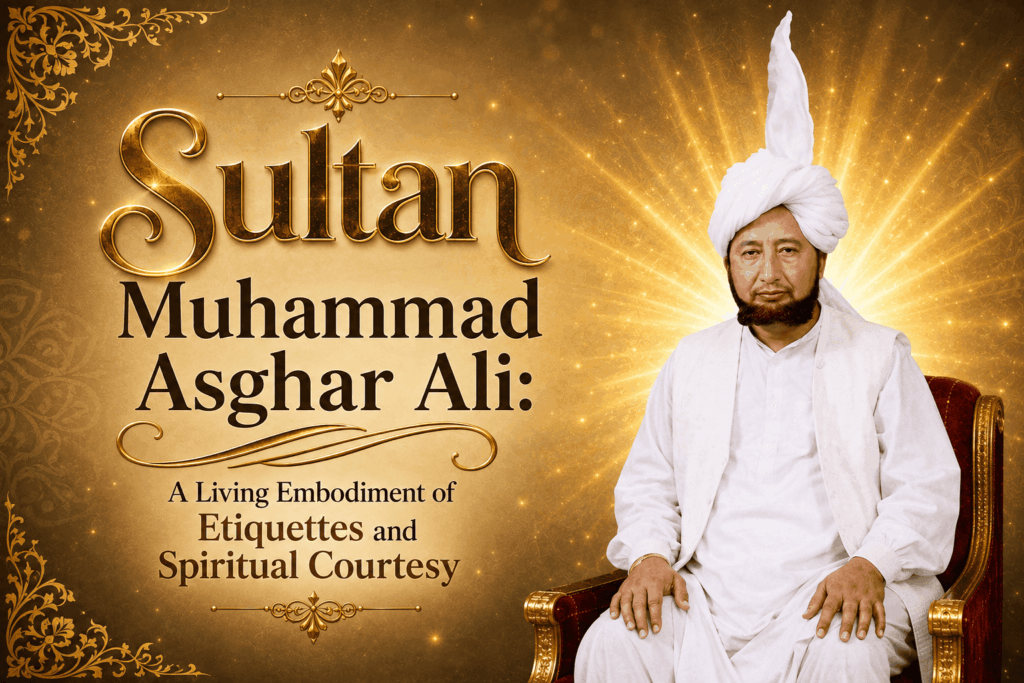
Sultan Muhammad Asghar Ali: A Living Embodiment of Etiquettes and Spiritual Courtesy
Written by: Afzal Abbas Khan
In the renowned book of Sufism Kashf al-Mahjub, Ali ibn Uthman Hujwiri (d. 481 AH) recorded the following saying of Abu Hafs Haddad Nishapuri (d. 267 AH),
“Sufism is entirely a matter of courtesy (adab). For every moment there is its proper courtesy, for every state there is its proper courtesy, and for every spiritual station there is its proper courtesy.”
Sultan al-Arifeen Sultan Bahoo also speaks of the importance of spiritual-courtesy (adab) in these words:
علم پڑھیا تے ادب نہ سکھیا کی لیناں علم نوں پڑھ کے ہو
“What is the benefit of acquiring knowledge if that knowledge does not cultivate courtesy within one’s being?”
At another point, he says:
بے ادباں نہ سار ادب دی گئے ادباں تھی وانجے ہو
جیڑھے تھاں مٹی دے بھانڈے کدی نہ ہوندے کانجے ہو
“The insolent are ignorant about respect; so they have gone astray from the code – Hoo. The earthen wares cannot become glass wares – Hoo,”
i.e., those who lack courtesy have no awareness of what courtesy truly is. They have no understanding of the rank, station, and virtue of others. They are like earthen vessels that, despite being made of clay, remain doubtful in their cleanliness and purity, and cannot be scrubbed clean in the way that vessels of metal can.
All the Sufis are in agreement that Sufism is nothing other than spiritual courtesy in its totality, and Sultan Bahoo gave the greatest importance to courtesy and its observance in his own method of spiritual training, for every act and every gesture of the perfected Sufi masters is cast in the mould of courtesy. Although courtesy has many dimensions and the conduct of the Sufis can be described in a great many ways, this article briefly presents those aspects of courtesy that were most visibly manifest in the life of our spiritual guide, the founder of the Islahee Jamaat (Edifying Movement), Sultan Muhammad Asghar Ali, so that guidance may be drawn from them to illuminate our own lives and to provide a lasting source of guidance for those who come after us. Through his own practical example, our spiritual guide showed us how he preserved within his heart and his conduct the spiritual inheritance that reached him from his ancestors, and how he revived these manners of courtesy afresh among people through his community and his spiritual training.
1- The Courtesy of Prayer (Salāt)
The most prominent aspect of his courtesy in prayer was his deep love for performing the congregational prayer (ṣalāt al-jamā’ah). Since the greater part of his life was spent in travel, the learned scholars (‘ulamā’) were always among his companions on every journey, and every effort was made to ensure that prayers were offered in congregation. Wherever he performed his prayer, he was most careful about purity and ensured that others were equally careful. During travel, the frequent problem arose that prayer mats or rows for prayer were not available at certain places. He, therefore, always kept prayer sheets as a permanent part of his travel provisions, so that if they arrived somewhere without prayer mats, these sheets were spread out and his travelling companions performed their prayers. He always observed the complete prayer as prescribed in the Hanafi school of jurisprudence, performing the optional Sunnah prayers and the voluntary prayers (nawāfil) with regularity. After the obligatory prayer, he would always make supplication, and after completing the remaining prayers of Zuhr, Maghrib and Isha, he would supplicate again. Before rising from his place after the supplication, he would recite the first testimony of Islamic Creed (Kalimah Ṭayyibah) three times in a moderately raised voice, and when he stood up, he would offer words of gratitude. He would then greet all those present with a handshake.
2- The Courtesy of the Remembrance of Allah
He would most often engage in the contemplation of the Personal Name of Allah (taṣawwur-e-Ism Allah Dhāt). Since the essential requirements of this practice are silence and solitude, whenever he intended to engage in this remembrance, his room would be cleared, and he would remain in solitude for some time, seated facing the direction of the Ka’bah, engaged in the remembrance of the Name of Allah. Although this was never directly witnessed, a specially made leather belt had been prepared for him so that if he needed to sit for a long time, it would provide support for his back. He instructed those who lived with him to take special care of the purity of this belt every day so that it remained free of dust and dirt.
The aloud remembrance (dhikr bil-jahr) of the Name Allah is another form of this practice, which the people of spiritual excellence of Sultan Bahoo’s spiritual order perform distinctively. When this was conducted in his presence, he would be seated on a bed or chair, and those engaged in the remembrance would divide into two rows, one on his right and one on his left, reciting the Name Allah aloud in equal numbers on both sides. When the session of remembrance concluded, he would remain seated for a considerable time with his eyes cast down in silence. He would then turn his attention toward those present, and if there was to be a further session of remembrance or a discourse, he would indicate accordingly. Otherwise he would bring the gathering to a close with supplication.
3- Courtesy to Remember the Name of the Exalted Prophet (ﷺ)
Whenever the blessed name of the Exalted Prophet (ﷺ) was mentioned in his gathering, he would place both thumbs to his lips and then raise them to rest upon his eyes, bow his blessed head in the manner of one bowing in respect, and close his eyes. If he was in conversation and the name of the Exalted Prophet (ﷺ) was mentioned, whether in the context of a question or in description of qualities and perfections, he would most often join both hands together in a gesture of particular modesty and admiration and complete the mention of the Exalted Prophet (ﷺ).
4- Courtesy of Mentioning the Predecessors: Prophets, Companions and Saints
Whenever the Prophets, the noble Companions and the friends of Allah Almighty came to be mentioned in his conversation, he would use the appropriate respectful titles before and after their names, according to each one’s rank. If any Prophet or Messenger was mentioned, he would precede the name with ‘Honourable’ or “Sayyadna” and follow it with “(A.S./peace be upon him).” Similarly, whenever a Companion of the Exalted Prophet (ﷺ) was mentioned, he would invariably precede the name with “Honourable” and follow it with “(R.A./ May Allah be pleased with them).” To illustrate the care he took; if Honourable Umar Farooq (R.A.) were mentioned in conversation, most of us would say “Honourable Umar” and consider the requirement of respect thereby fulfilled. But if Honourable Umar Farooq (R.A.) were mentioned ten times in his conversation, he would precede the name with “Honourable/Hazrat” or “Sayyadna” and follow it with “(R.A.)” on every single occasion without exception. Likewise, whenever the friends of Allah Almighty were mentioned, he would use an honoured title before their name and “(R.A.)” after it.
5- Courtesy of Visiting the Friends of Allah
All who had the honour of being in his service and of observing him personally witnessed this aspect very prominently in his character: that he would visit the shrines of his own spiritual masters and of other Sufis with the utmost respect and humbleness. Observers would be moved to admiration at the level of spiritual station Allah Almighty had granted him, and yet they would witness this same great man presenting himself at the shrines of the Sufis in a manner of the deepest modesty and humility. This was in truth a lesson for the disciples who lived in his service, showing them how one ought to present oneself in the company of spiritual personalities.
When he travelled to the north of the court of Sultan Bahoo, meaning to the regions lying north of that court, he would be mindful even during rest that his feet not face southward, because the sacred shrines of Sultan Bahoo, Sultan Sayyad Bahadur Ali Shah and Sultan Muhammad Abdul Aziz lay to the south. He would say,
“I feel shame at the thought of sleeping with my feet directed toward the shrines of these blessed souls.”
When he stayed for nine nights or twenty-one nights at the court of Sultan Sayyad Muhammad Bahadur Ali Shah, the room prepared for his rest was to the north of the sacred court, and on every occasion, it was observed that he never rested with his back turned toward the south. He would lie on his back facing upward, or if he lay on his side, he would keep his face turned toward the south. This was his practice even when sitting in a vehicle, travelling somewhere, entering a masjid or performing ablution: if his back happened to be facing the direction of the sacred court, he would turn and position himself differently. For the entire duration of his stay at the court of his spiritual master, he would sleep on the floor and never rested on a bed. In the final year or two of his life, a bed was prepared for him, regarding which he said,
“Pir Sayyad Muhammad Bahadur Ali Shah has commanded me to use a bed here.”
He said to his companions to cut down the legs of this bed from beneath, so that it sat very close to the ground, because he had been commanded to use a bed and could not refuse, yet did not wish to sleep elevated upon one. So, he had its height removed entirely.
Similarly, whenever companions would laugh or speak loudly at the shrine, he would stop them with a glance of his eyes, indicating that this was the court of his blessed spiritual master and that speaking loudly, laughing aloud, or engaging in inappropriate conversation in such a place was contrary to proper courtesy.
6- Courtesy in Speech/Conversation
His conversation was always an embodiment of courtesy from beginning to end. His choice of words was supremely refined, free of all affectation or pretence. His words were always of the kind that took up residence in the heart. When he talked with various spiritual personalities and learned scholars, he would employ the technical terminology of the sciences of Islamic knowledge, but when communicating with ordinary people who were not highly educated, he would speak in entirely simple language, even adopting their own idioms and expressions.
He would not laugh in a loud and boisterous manner. On the rare occasion that a full laugh did arise from him, it was in a beautiful and dignified manner, but as a rule he would simply smile. His voice and tone in conversation were always measured and gentle, and he would raise his voice only when a large gathering of people were seated around him, and it was necessary for his voice to carry to all. Yet even when his voice was gentle, it was a sign of the spiritual power of his blessed being that however large the gathering, he would speak without a microphone and his voice would reach every single person present. His voice was not very loud nor was it rough or strained; it was comparatively fine and delicate in quality, yet it carried a dignity and grandeur within it. He always spoke with gentleness. When he entered any gathering, he would say ‘Assalam o Alaykum’ with such sincerity and love in his voice and manner that the entire gathering would turn toward him and affection for him would spontaneously arise in the hearts of all those present.
7- Courtesy of Handshake
The most prominent feature of his practice of greeting with a handshake was that he never shook hands inattentively. Whoever he greeted, he would extend his generous hand with complete warmth and would not pull it away until the other person freed it first. He would direct his full attention and gaze toward whoever he was greeting so that the person would not feel he was being met with indifference. After the congregational prayer, he would shake hands with all those who had prayed, and companions who joined him for all five prayers would enjoy this honour of greeting again and again at each prayer. If an unknown person arrived, he would embrace him and ask after him with complete care and interest. On many occasions during the summer months, farmers, labourers and the poor who arrived drenched in sweat would also embrace him, and not once was any sign of repulsion or inclination to move away ever seen upon his blessed face. He would return the embrace of whoever embraced him, for as long as the person held him, and he never refused anyone an embrace.
8-Courtesy of Taking Meals / Dining
He would wash his hands both before and after eating meals. A particular towel was set aside for mealtimes, and it would be spread across his lap when he sat down to eat. He would often dry his hands with this towel. When he had finished eating, he would look around at all those seated at the spread. If everyone had finished, he would raise his hands, say ‘Alḥamdulillāh’ aloud, and recite the supplication established in prophetic tradition after the meal. But if even a single child at the spread were still eating, he would not make the supplication until that person had finished. He always waited for everyone to complete their meal.
Sahibzada Sultan Ahmed Ali narrates an event that he saw himself: one day, as the blessed spiritual guide was entering the inner door of the house on his way home, he noticed a morsel of bread lying on the ground. He had it picked up, held it and kissed it, then said,
“Do not allow any disrespect to the food (langar) of Sultan Bahoo. If blessings are not valued, they are withheld.”
When he travelled to different regions, he would enjoy eating the local specialties of those areas. If his journey took him to Dera Ismail Khan, for instance, he would eat the local traditional dish (ṣaubat) with great pleasure. When on a hunt, he would delight in eating rabbit, partridge, etc.
9- Ethics of the Hunt
He would say regarding the hunt,
“We prefer to hunt in quiet, undisturbed places so that we may have some exercise, refresh the mind, find the opportunity for silence, and maintain the tradition of our elders.”
He would hunt partridge, mountain sheep, and deer with a rifle, and rabbit with trained hunting dogs. The dogs used in the hunt were trained in accordance with the guidelines established by the jurists of Islamic law. A firm rule in his circle of hunting was that no hunter was permitted to pluck fruit from an orchard. If berries were growing in someone’s field, no one was allowed to throw a stone at them or pick and eat them. Breaking fresh vegetables from crops while passing through fields was strictly forbidden. Similarly, in rabbit hunting, when a pair of dogs was sent after a rabbit and the rabbit escaped them, he would change his route so that the same rabbit would not be encountered again that day. He would say,
“We do not hunt for meat. We hunt to nurture discipline in people. A rabbit that has escaped may be hunted the following day, but the same dog pair cannot be sent after it again on the same day.”
If anyone did otherwise, he would rebuke them severely. Even in hunting grounds he would arrange for the congregational prayer, leading it alongside the memorisers of the Glorious Qur’an, reciters and scholars of Islamic learning.
10- The Courtesy of Horsemanship
He never mounted a horse without wearing his turban. Wearing the turban was part of his courtesy in horsemanship. His close disciple Malik Muhammad Hayat Ghanjera narrates that if he saw anyone riding a horse without a turban or without their head covered, he would express disapproval and say,
اتوں مندر، تھلوں مسیت
i.e., A temple above, a masjid below.
The meaning was that the lower part, riding a horse, is a fine thing, but the upper part, the head, has not observed the requirement of proper conduct.
In the final years of his life, he occasionally rode a horse rather than walking during hunts. At such times he would wear a woollen cap on his blessed head rather than a turban. Whenever he prepared to mount a horse, he would always perform fresh ablution first. If a horse had not been cleaned and groomed, he would not ride it either, saying,
“The cleanliness of the horse is itself part of the etiquette of riding.”
11- The Etiquette of Keeping and Caring for Horses
Horsemanship and the keeping of horses are two distinct matters. The proper care of horses is itself a subject on which an entire detailed book could be compiled. Briefly, in his etiquette of horse-keeping, he would always instruct that the horse’s stable be kept clean, and he would forbid tying a horse to a hard surface. Although the horse is a powerful animal, its physical constitution is such that it should not be fastened to a hard surface, so that when it lies down it may rest in comfort. He also strictly forbade anyone from cursing or using abusive language toward the horses. He would say,
“If a horse is behaving badly, that is, if it keeps biting and striking people, a stick may sometimes be kept for its training to bring it under control, but the horse must never be shown a shoe or anything else that would be degrading to it.”
12- Courtesy for Spiritual Training
Although courtesy is itself a form of spiritual training, he was equally attentive to the courtesy and dignity of those who were in his care. He would look after their needs in accordance with every season, attending to their clothing, food and drink. He would always urge his companions to guard the dignity and self-respect of one another, saying,
“Do not speak a word and do not perform an act that would wound the self-respect of your companion on the path, causing him to feel lesser than you or others. Rather, honour him so that he feels equal to all his companions.”
He treated everyone with warmth and kindness, and it was for this very reason that he became the life and soul of every gathering through his compassion, character and the spiritual presence of his being. If he looked to the right, the entire gathering would look to the right. If he looked to the left, the entire gathering would look to the left. If he smiled, the entire gathering would smile. When he spoke, people would look toward him smiling, and at his every word the sound of Subḥān Allāh would rise from the gathering. When he sat with his eyes lowered in a blessed thought, or when he closed his eyes and entered a state of spiritual meditation, no one dared to raise their eyes. Every person would sit with lowered gaze, feeling the majesty and awe of his blessed gathering.
13- Respect for Masjid
He had a profound love for the masjid. Whenever he travelled, his convoy would typically consist of three to four vehicles carrying his disciples who were under his spiritual training, and he would forbid them from using excessive water for ablution along the way so that the masjid’s resources would not be wastefully spent. Similarly, regarding the masjid he had built at the shrine of Sultan Bahoo, he was very firm that all materials related to that masjid be used solely and exclusively for the masjid itself. Regarding the horses, he says,
“These horses have been entrusted to me in the service of my blessed spiritual master. We are therefore not permitted to sell them for our personal needs. However, for the masjid, we have permission to sell them.”
In other words, if a situation were ever to arise where funds ran out and work on the masjid was in danger of stopping, the horses could be sold solely for the sake of the masjid. Otherwise, selling them was not permitted.
Here I wish to share a particularly beautiful and moving account of his love for the masjid:
“The horse he rode most often in his life and with which he performed tent-pegging was dearest to him. Its name was Kabutra. He sold it for the blessed masjid. Those who lived with him know that after that horse, the era of his tent-pegging was never quite the same, and the attachment he had with that horse never formed again with any other. He narrated the account himself: The work on the blessed masjid was underway, and the funds had run out. I was thinking about where to find money, because I dislike asking others. He said: one day I was having lunch at a place in Sargodha District when I received a spiritual communication from the blessed court inwardly, telling me to sacrifice the most beloved thing for the masjid. I asked: which one, my master? The command came from the blessed court: sell the horse Kabutra. He said: my attachment to that horse was such that as I raised the morsel to my mouth, it remained in my hand for a few moments as I thought: shall I really sell this horse too? But, he says, without any hesitation, I sold the horse Kabutra for the blessed masjid.”
There is another equally beautiful example,
“When the minarets of the blessed masjid were being built, he gave the design to the craftsmen and engineers and then departed on a journey. When he returned some months later, the minarets had not been built as he had instructed. In his view, the minarets as built were both detracting from the dignity of the masjid and were not structurally sound. He therefore decided to have the minarets demolished and rebuilt. However, he expressed the concern that demolishing a minaret of the masjid might fall into the category of an act of disrespect. Although he himself possessed the relevant knowledge, he consulted the scholars within the community, including Mufti Ashfaq Ahmad, Mufti Salih Muhammad, and other learned scholars, asking: the minaret that has been built does not meet the standard of beauty and strength we desired. I wish to build a minaret more beautiful and more solid than this one. Is it permissible to demolish this minaret? The scholars were themselves struck with admiration at his extraordinary caution and his love for the blessed masjid, and they replied that yes, this could certainly be done. After receiving their opinion, he issued the instruction that the minaret be demolished and new minarets be built, more beautiful and stronger than before.”
The manners of courtesy recorded above are those that were present to mind at the time of writing. In truth, his every word, his every action, his every movement and his every stillness were all steeped in courtesy, and he was the living embodiment of the saying,
“Sufism is entirely a matter of courtesy (adab).”
It is by courtesy alone that the Sufi masters are recognised. May Allah Almighty grant us the ability to adopt these manners of courtesy in our own lives.
This article was originally published in Urdu in the Monthly Mirat-ul-Arifeen International Magazine, December 2020 issue.
To cite the original article:
Khan, Abbas. “Sultan al-Faqr Honourable Sultan Muhammad Asghar Ali (R.A.): A Living Embodiment of Spiritual Courtesy”. Mirrat-ul-Arifeen International, December 2020. Available at https://www.mirrat.com/article/42/970